Showing posts with label classroom connection. Show all posts
Showing posts with label classroom connection. Show all posts
Wednesday, March 25, 2015
Snatch
On Learning That Today I Will Get My SEVENTH New Student This Year
Snatch me back from the edge.
I might jump
or I might fall
and I'm not sure that thing about growing wings
on the
way
down
will actually work.
©Mary Lee Hahn, 2015
True story.
7 of my (now) 27 students were not with us on the first day of school. That means about one-fourth of my class is comprised of new students. We are in about the 26th week of school, so that means I've averaged about one new student every month. No big deal? Imagine what that does to the classroom community you've worked so hard to build...and rebuild...and rebuild...
Sigh.

Monday, March 23, 2015
Next Read Aloud
NEXT READ ALOUD
Book wanted:
Must
grip listeners,
hold interest.
Make them
clutch cliffhangers,
cling to characters.
Encourage
relaxed conversations,
and unloose imaginations.
Culminate
a community of readers
and an elementary school career.
©Mary Lee Hahn, 2015
Thursday, December 11, 2014
Haiku-a-day -- Decorating Cookies
 |
| Yes, I do believe that's Ronald McDonald you see there... |
Decorating Cookies
rolled sugar cookies --
31-year tradition --
end-of-year icing
©Mary Lee Hahn, 2014
Friday, April 4, 2014
Our Wonderful World: The Catacombs of Kom el Shoqafa
 |
| The details of my Poetry Month project can be found here. |
 |
| Tripadvisor.com |
We All Wait
What's a forgotten catacomb to do?
My tunnels sprawled,
my columns endured,
my stairways persevered.
What's a forgotten catacomb to do?
I cradled the bones of the dead
in silence.
My statues stood guard
in secrecy.
And I waited.
We all wait.
Sometimes
we even know why,
or what for.
Never
in all my centuries
would I have imagined
what would break the monotony
and end my waiting.
What's a forgotten catacomb to do?
A thousand years I waited.
Then a donkey fell through my roof
and the silence, the secrecy, and the waiting were over.
Who would have guessed?
©Mary Lee Hahn, 2014
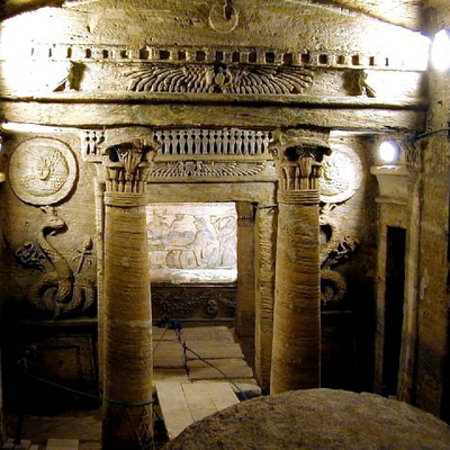
This is the first wonder I knew absolutely nothing about. Based on my experience yesterday, I knew we would need to do a bit of research before we started writing. I showed my students the image above and we brainstormed the questions we hoped to have answered by our research:
Turns out this was the perfect wonder for personification. You could write from the point of view of the catacombs themselves (as I did) or from the point of view of the donkey that fell through the roof in 1900, leading to the rediscovery of the catacombs. You could be a serpent guarding the doorway, a statue, a dead person buried there, or one of the shards for which the catacombs are named: "Mound of Shards." You could be the desert around it, the sky above it, or the water that's flooded the lowest level.
Carol has a Colosseum poem from yesterday at her blog, Carol's Corner.
Kevin's poem today is multimedia.
This is the first wonder I knew absolutely nothing about. Based on my experience yesterday, I knew we would need to do a bit of research before we started writing. I showed my students the image above and we brainstormed the questions we hoped to have answered by our research:
What are catacombs?My reading minilesson plans called for us to think about how we can determine the speaker in a poem (or a text), and in writing, we would try to write from an interesting point of view.
Are there traps?
Can tourists go there?
Are there kings, or treasure?
Where are they?
How old are they?
How big are they?
What are they used for?
Turns out this was the perfect wonder for personification. You could write from the point of view of the catacombs themselves (as I did) or from the point of view of the donkey that fell through the roof in 1900, leading to the rediscovery of the catacombs. You could be a serpent guarding the doorway, a statue, a dead person buried there, or one of the shards for which the catacombs are named: "Mound of Shards." You could be the desert around it, the sky above it, or the water that's flooded the lowest level.
Carol has a Colosseum poem from yesterday at her blog, Carol's Corner.
Kevin's poem today is multimedia.
Thursday, April 3, 2014
Our Wonderful World: The Colosseum
|
| Details of my Poetry Month Project can be found here. |
3. Colosseum
 |
| Wikipedia |
Broken soup bowl,
tarnished crown,
gaping eyeholes,
center of town.
Shaken, crumbled,
still you stand.
By history humbled,
yet you're grand.
©Mary Lee Hahn, 2014
Carol Varsalona has a Colosseum poem for today on Notegraphy. Kevin's Colosseum Fibonacci poem showcases HaikuDeck.
Carol's poem from yesterday about Stonehenge is at Carol's Corner.
Kevin wrote a Stonehenge poem in Notegraphy yesterday. (I can't wait to give this app/website a try!)
It was in my plans for us to write similes and metaphors about the Colosseum as a possible way into our poems. Good thing I tried that before I had my students do it -- I learned that you can't write much when you know next to nothing about your topic. (DUH.) So we started with some quick research.
Bless you, KR. I knew I was ready to pull them all back together for some brainstorming when K said aloud, "I wonder how much cereal it would hold? It looks like a bowl!" We had our first simile.
Then, as they fed me facts they had learned, we worked together to bend them into similes or metaphors. Here's we came up with:
•The colosseum is a bowl. How much cereal would it hold?
FACT: It is big.
•It is as big as the moon. (Nice example of hyperbole!)
FACT: It is old, made in 70 AD.
•The Colosseum is nearly as old as the Pyramid of Giza. (We had a good conversation about why this isn't a simile. It is simply stating how old the Colosseum is. And it's not even true. The pyramid is WAY older.)
•My teacher is nearly as old as the colosseum. (Now that we're comparing two unlike things, we have a simile. And hyperbole, please!!)
•The colosseum is like a crown on a princess’ head. (Simile)
•The colosseum is a crown. (Simile transformed into a metaphor)
FACT: It's made of concrete and stone.
•The Colosseum is as sturdy as the tree branch Ry climbed on. (We wanted a simile that compared the Colosseum to something that really wasn't so sturdy, since it is falling apart. Our read aloud is AS EASY AS FALLING OFF THE FACE OF THE EARTH, and Ry is the main character. You can probably guess what happened to the tree branch he climbed on!)
FACT: 500,000 people were killed and over a million animals were killed there.
•The colosseum is a graveyard.
FACT: It is old, made in 70 AD.
•The Colosseum is nearly as old as the Pyramid of Giza. (We had a good conversation about why this isn't a simile. It is simply stating how old the Colosseum is. And it's not even true. The pyramid is WAY older.)
•My teacher is nearly as old as the colosseum. (Now that we're comparing two unlike things, we have a simile. And hyperbole, please!!)
•The colosseum is like a crown on a princess’ head. (Simile)
•The colosseum is a crown. (Simile transformed into a metaphor)
FACT: It's made of concrete and stone.
•The Colosseum is as sturdy as the tree branch Ry climbed on. (We wanted a simile that compared the Colosseum to something that really wasn't so sturdy, since it is falling apart. Our read aloud is AS EASY AS FALLING OFF THE FACE OF THE EARTH, and Ry is the main character. You can probably guess what happened to the tree branch he climbed on!)
FACT: 500,000 people were killed and over a million animals were killed there.
•The colosseum is a graveyard.
Wednesday, April 2, 2014
Our Wonderful World: Stonehenge
|
| Details of my Poetry Month Project can be found here. |
2. Stonehenge
 |
| Wikipedia |
We stand.
Sun warms us,
wind pushes us,
people stare at us.
We wait.
Moon comforts us,
rain gouges us,
people stare at us.
We know.
Tools made us,
ancients moved us,
people stare at us.
We endure.
History created us,
future sustains us,
people admire us.
©Mary Lee Hahn, 2014
S t o n e h e n g e
feels hard,
can lift,
sounds silent
very strong
reaches high
to the sky
feels rough.
©JB, 2014
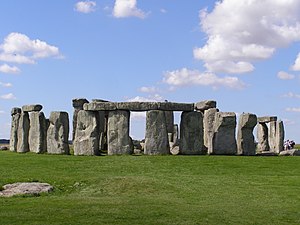
We did another two-column brainstorm for today's poems. This time we thought about what moods the picture evoked, and what sensory images we might include in our poem.
There's so much we don't know about Stonehenge. I tried to capture the solid silence of the stones, and the wonder and amazement that we continue to feel in the presence of this mighty ring of standing stones.
EDITED AFTER SHARING WITH MY CLASS: The last line of my poem used to read "people stare at us." AH suggested that perhaps since the poem shifts in that stanza to bigger themes, the last line could be "people admire us." I totally agreed and have made that change! Thanks, AH! (This is what I love about being a part of a community of writers...in my classroom!)
Carol and Kevin both wrote poems yesterday for The Great Pyramid of Giza. Check them out at Carol's Corner and Kevin's Meandering Mind.
Tuesday, April 1, 2014
Our Wonderful World: The Great Pyramid of Giza
|
| Details of my Poetry Month Project can be found here. |
 |
| Wikipedia |
TIME
Time
in the desert
is as vast as the sky
expanding across blue distance.
Ancient as sand, changeless and thirsty,
time waits, encased in a monumental tomb of stone.
©Mary Lee Hahn, 2014
Stacking stones
all day and all night.
Just to make a pyramid
to store dead people.
This is all for naught.
But the Pharaoh wants it,
so he gets it.
©VS, 2014
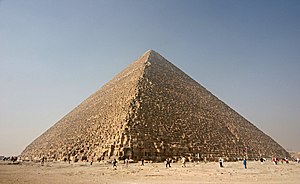
This year, because April 1 is on a Tuesday, I am including my students in my writing process for this first week. Yesterday we looked at this picture of The Great Pyramid of Giza and did a two-column brainstorming activity with DENOTATION on the left and CONNOTATION on the right. Denotation is where we listed the exactly what we could see in the picture, or facts we gathered from further research. Connotation is where we listed what those facts made us think about, or feel. My denotations were big, old, triangle, sand, desert, brown. My connotations were important, valuable, knowledgeable, solid, balanced, sturdy, strong, classic, time, change, changelessness, vast, empty, silent, dry, hot, thirsty. You can see which ones made it into my poem!
It was fascinating to watch the students' writing move immediately in unique directions based on their own connotations. After 5 minutes of my own writing, I circled the room and found another pyramid-shaped poem, two acrostics (mummy and pyramid), three different voices (a slave, the pyramid, and a conversation between the pyramid and a visitor), and poems about the sand, grave robbers, and oldness. I hope a couple of them will allow me to post their poems here later today!
Subscribe to:
Comments (Atom)